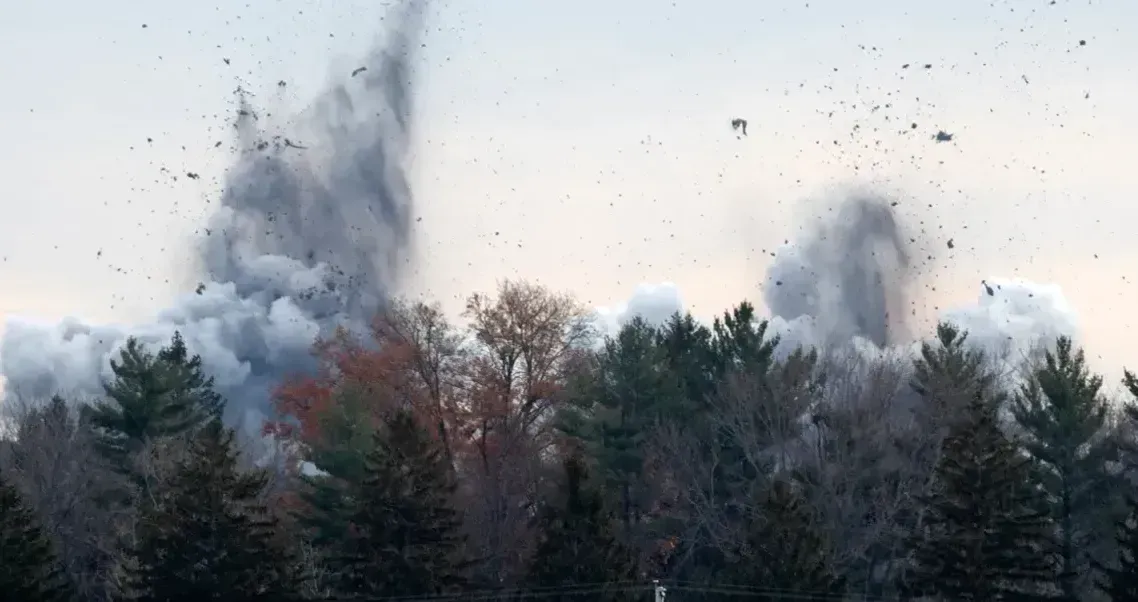
A tense atmosphere gripped southeast Iowa this week as the U.S. Army carried out a planned detonation of nearly five tons of unstable lead azide explosives. The operation took place Wednesday morning at the Iowa Army Ammunition Plant in Middletown, where officials say the materials had recrystallized and become too dangerous to move without risking a spontaneous eruption. While the military describes the event as a necessary safety measure, the act sent a plume of potentially toxic lead dust drifting across the landscape, triggering evacuations and leaving local residents anxious about long term contamination.
Witnesses reported feeling a distinct percussion from the blast, while video footage captured clouds of gray and white smoke rising over the facility shortly after 9 a.m. To mitigate the fallout, the Army utilized massive sand barriers and water walls designed to trap particulate matter. Despite these efforts, atmospheric modeling suggested that lead dust could travel up to 100 miles southwest, potentially crossing into Missouri. In response to the looming danger, soldiers went door to door ordering evacuations in Middletown and surrounding areas, with FEMA stepping in to provide hotel lodging for displaced families through Friday.
Local reactions have been marked by frustration and fear, particularly regarding whether sufficient warnings were given before the countdown began. Some farmers spent their Sunday nights frantically collecting soil samples to establish baselines before any fallout occurred, fearing that lead—a potent neurotoxin known to cause permanent developmental damage in children—could settle permanently into their land. Many residents taped their windows shut or altered holiday travel plans to escape what they perceived as an avoidable environmental hazard.
Government officials have remained optimistic following the detonation, citing initial air quality readings that showed no detectable airborne lead throughout the region. Governor Kim Reynolds stated that early feedback suggests the mission was a success, and President Donald Trump noted via social media that mitigation efforts exceeded expectations. However, independent scientists warn that air monitors only tell part of the story. Experts argue that since lead settles into soil and surfaces rather than remaining aloft indefinitely, it will take significant time and rigorous testing to determine exactly how much toxin landed on private properties and whether extensive government led remediation will actually occur.